
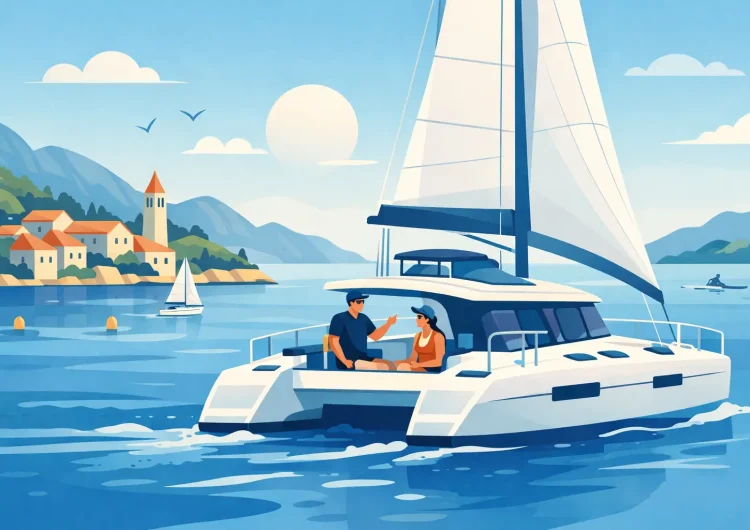
Catamaran School Croatia: What to Expect
You can learn more in one week on the Adriatic than in months of reading about sailing at home. A good catamaran school Croatia experience puts you on the water quickly, but it also gives you enough structure to build real confidence – not just holiday memories, but skills you can use again.
For many guests, Croatia makes sense for catamaran training because the conditions are friendly without being boring. You get steady summer winds, short island passages, clear line-of-sight navigation and plenty of sheltered spots to pause, practise and reset. Add warm weather, clean water and harbours full of sailing life, and the learning curve feels far more enjoyable.
Why choose a catamaran school in Croatia?
A catamaran is not simply a wider sailing boat. It behaves differently under sail, handles marinas in its own way and gives a very different onboard feel. That matters if you are planning future charter holidays, thinking about skipper training or simply want to try sailing in a way that feels stable and social.
Croatia is a strong place to start because the environment works in your favour. Distances between islands are manageable, which means less time on long open crossings and more time actually practising manoeuvres, sail trim, anchoring and route planning. Weather is usually good in the main season, although it still changes enough to teach you respect for local forecasts and sea conditions.
There is also a practical side. If you are already planning a coastal break, sailing tuition can fit naturally into your trip rather than becoming a separate expedition. That is especially appealing for couples, families or small groups who want active days on the water with comfortable evenings ashore.
Who a catamaran school Croatia course suits best
This kind of course is not only for future professionals. In fact, many people who book catamaran training are ordinary holidaymakers who want a more hands-on Adriatic experience. Some are complete beginners. Others have monohull sailing experience and want to understand how a catamaran differs before they charter one.
It suits couples well because the boat layout often feels more relaxed and cooperative than a smaller training yacht. It also suits groups of friends who want to combine learning with a proper seaside holiday. Families can benefit too, although the best format depends on the age of the children and how intensive the course is.
If you want a fast-track certificate with a tight schedule, that can be done. If you want a lighter introduction with room for swimming stops, coastal meals and time to enjoy the islands, that can work too. The right choice depends on whether your priority is qualification, confidence, or a blend of both.
What you actually learn on board
A quality catamaran school in Croatia should give you far more than a turn at the helm. You should expect to cover boat familiarisation, safety routines, handling under engine, sail handling, basic navigation and close-quarters manoeuvring.
The biggest surprise for many first-timers is marina work. Catamarans are stable and spacious, but they can be demanding in tight harbours because of their beam and windage. Learning how twin engines help with control is one of the most useful parts of the course. Done properly, this is where a lot of nervousness disappears.
You will also spend time on anchoring, mooring lines, fenders and communication on board. None of that sounds glamorous on paper, but these are the details that make a real difference later when you are responsible for the boat yourself. Good instruction should explain not just what to do, but why it matters and when conditions change the decision.
Navigation in Croatia is often ideal for learners because it feels real without being overwhelming. You can work with charts, identify headlands and islands visually, and build route awareness in a setting that is both practical and memorable.
What a typical training day looks like
Most days begin with a weather check, route discussion and a short briefing. Then you head out and rotate through tasks so everyone gets time on the helm, lines and sails. The pace depends on the school, the wind and the confidence level of the group.
Some courses are intensive from morning to evening, which is a good fit if your aim is progression in a short window. Others leave more space for lunch ashore, swimming stops and slower scenic passages. Neither style is automatically better. If you are on holiday, the best experience is often the one that leaves room to enjoy Croatia as well as learn.
This is why staying close to the coast can make such a difference. On Murter, for example, you are already in a sailing setting, with easy access to island routes and the wider Dalmatian coastline. That means less time commuting and more time actually being on the sea.
Catamaran school Croatia costs and what affects them
Prices vary quite a bit, and the cheapest option is not always the best value. The cost usually depends on the size and quality of the catamaran, the instructor ratio, the length of the course, whether certification is included and whether accommodation is part of the package.
A bare training fee may look attractive at first, but you should check what is and is not covered. Fuel, marina charges, certification fees, food and overnight stays can change the final figure quickly. If you are travelling as a couple or group, a package that combines accommodation with sailing can be simpler to budget for.
Season matters too. High summer brings warm water and lively coastal atmosphere, but it also tends to mean higher prices and busier marinas. Shoulder season can offer a better balance if you want more space and slightly calmer conditions, although the weather is less predictable.
Why Murter works so well for learning
Murter is one of those places that makes sailing feel close, accessible and part of everyday coastal life. You are not hidden away from the sea – you are living beside it. That changes the rhythm of the whole trip.
For guests who want more than a room and a beach towel, this matters. You can spend the day learning the basics of catamaran handling, then return to shore for an easy evening walk, a swim, or dinner with local Dalmatian flavours. The holiday still feels restful, but it has purpose and momentum.
This is also why an experience-led stay can work so well here. At Nautica Flats Murter, the appeal is not just where you sleep, but how easily you can combine beach time, boating and active days outdoors from one comfortable base.
How to choose the right course for your holiday
Start with your real goal. If you mainly want confidence for future charters, look for practical training with plenty of hands-on boat handling. If you want a formal qualification, check exactly which certification is offered and how much assessment is involved.
Then think about pace. Some travellers love an intensive programme. Others enjoy learning more when there is time to absorb it between sessions. If you are travelling with a partner or family, the right format may be the one that balances structured tuition with enough free time to enjoy the destination.
Instructor style matters as much as syllabus. The best teachers are calm, clear and good at reading the group. A holiday learner does not need shouting and jargon. You need simple explanations, steady progress and a sense that mistakes are part of learning.
Finally, consider the setting around the course. A beautiful sailing area is not just a bonus. It affects motivation, comfort and how much you enjoy the process. Croatia does this particularly well because the training ground and the holiday destination are often one and the same.
A few trade-offs worth knowing before you book
Catamaran training is rewarding, but it is still training. If you book a serious course, expect some long days, repetition and weather-led changes to plan. If your idea of a perfect break is total spontaneity, a full course may feel too structured.
The opposite can happen too. A very relaxed sailing taster may be enjoyable, but it may not leave you with enough practice to handle a catamaran independently later. That is why expectations matter. Ask whether you want a memorable introduction or a proper skill-building week.
There is also the simple question of sea comfort. Many people find catamarans more stable than monohulls, which is a genuine advantage. Even so, wind, chop and marina manoeuvres can still feel demanding at first. That is normal, and it usually settles quickly once you understand the boat.
If you are looking at a catamaran school Croatia option for your next coastal break, think of it as more than an activity slot. Done well, it becomes part of the whole shape of the holiday – mornings with purpose, afternoons on beautiful water and evenings back on shore with that satisfying feeling of having properly learned something. And that is often what makes a trip stay with you long after the tan has gone.